 Get Listed


Published: 25th September 2026 | Author: David Paul Edwards | Reading Time: 7 minutes
Office desks form the foundation of most workplaces. Whether you are furnishing a small office, creating workstations for a growing team or redesigning an open-plan floor, choosing the right desk can make a noticeable difference to how effectively the space works.
Size is important, but it is only part of the decision. Desk configuration, available floor space, cable management, privacy, technology and the way employees work should all influence your choice.
A large individual desk might be ideal for someone who needs plenty of working space, yet inefficient for a team sharing an open office. Likewise, bench desks can use floor space extremely well, while height-adjustable desks provide greater flexibility for employees who want to change position during the working day.
At Second User Furniture, our current range includes office desks for individual workstations, open-plan teams, home offices and modern flexible workplaces.
Choosing the Right Office Desk
Before deciding on a particular style, think about how the desk will actually be used.
Someone working with two monitors, paperwork and specialist equipment may need considerably more surface area than an employee who primarily uses a laptop. Teams working together may benefit from bench configurations, while roles requiring greater privacy could be better suited to individual workstations.
There is also the wider office layout to consider. A desk that looks perfectly proportioned in a showroom can feel very different once chairs, storage, screens and walkways are added around it.
The right desk therefore needs to work for both the individual employee and the workplace as a whole.
Office Desks at a Glance
Bench desks: create efficient workstation layouts for teams and open-plan offices.
Freestanding desks: provide greater separation and flexibility for individual workstations.
Sit-stand desks: allow employees to alternate between seated and standing positions.
Compact desks: work well where floor space is limited or smaller workstations are required.
Large desks: provide additional surface area for multiple monitors, documents and equipment.
Desks with cable management: help organise power, data and technology beneath the work surface.
Rather than choosing one desk type for an entire business, many modern workplaces benefit from combining different configurations according to the needs of individual teams and roles.
Start with the Space Available
Accurate measurements make office planning considerably easier.
Measure the room itself, but also consider doors, windows, radiators, columns and other permanent features. Once workstations are positioned, employees still need enough room to pull chairs back and move comfortably around the office.
Storage takes up space too. Under-desk pedestals, cupboards and filing cabinets need to be included in the plan rather than added after the desks have been installed.
For team areas, consider the complete footprint of a bank of desks rather than the dimensions of one individual position. Screens, cable trays and chairs can all affect how much floor space the finished workstation requires.
A well-planned office should feel organised rather than packed with as many desks as possible.
What Size Office Desk Do You Need?
Commercial office desks are available in many widths and depths, so there is no single correct size.
A 1200 mm desk can provide a practical workstation where space is limited. Moving up to 1400 or 1600 mm gives employees more room for monitors, keyboards and documents, while larger surfaces may suit roles involving drawings, paperwork or specialist equipment.
Depth matters as well. A generous work surface gives employees more flexibility when positioning monitors and other equipment.
Before choosing, consider what will permanently live on the desk. Two large monitors can quickly consume the usable area of a compact workstation.
It is usually better to choose dimensions around genuine working requirements rather than simply selecting the largest desk that fits.
Bench Desks or Individual Desks?
This is one of the biggest decisions when planning a modern office.
Bench Desks
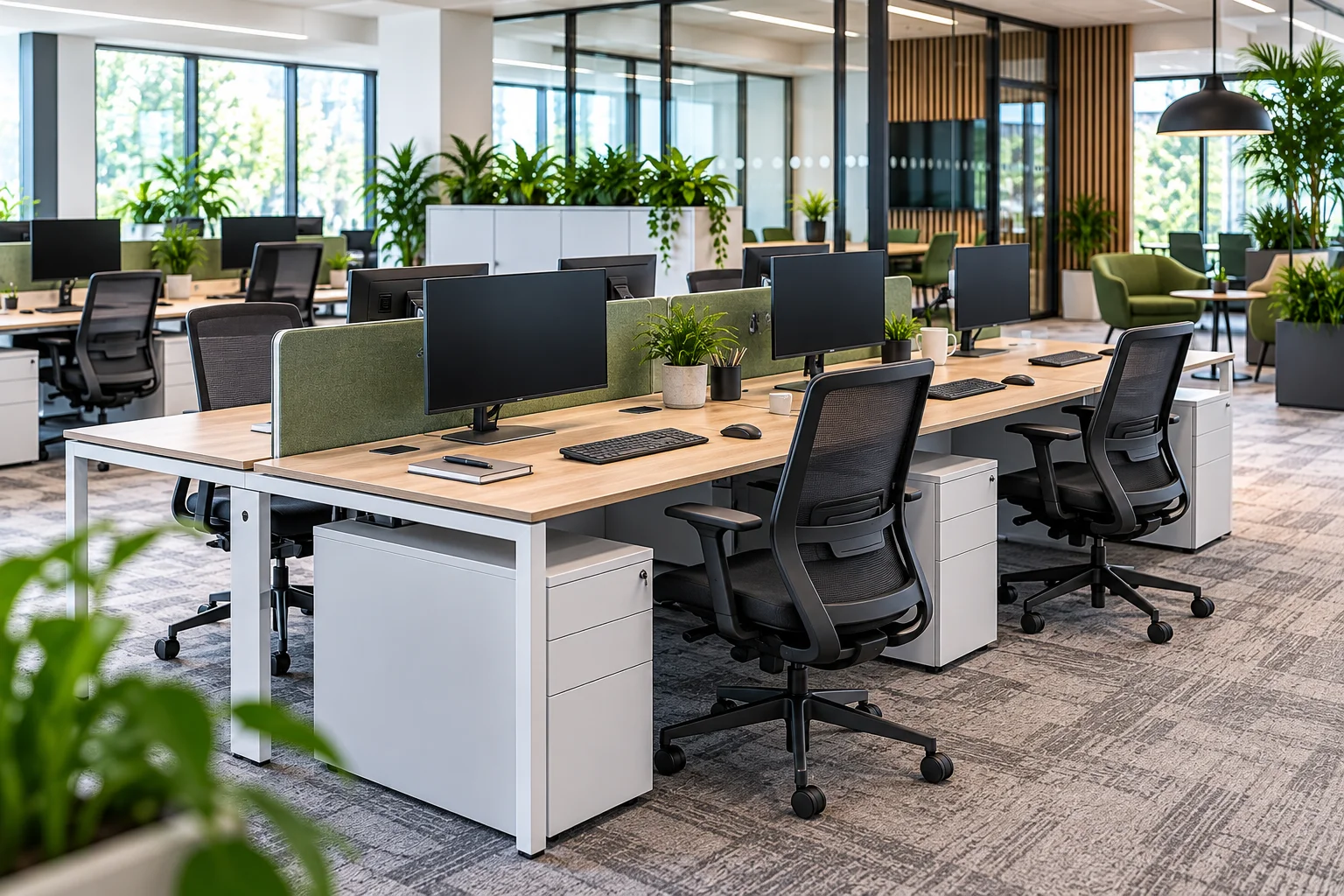
Bench desks allow several workstations to share a common frame structure. This can make excellent use of floor space, particularly for departments where employees work closely together.
They also create an organised visual layout because rows or banks of workstations follow the same dimensions and alignment.
Screens can provide separation between employees without completely isolating them, while shared cable management helps keep technology organised underneath the desks.
Bench systems are particularly useful when furnishing larger teams because many ranges can be configured in banks of two, four, six or more positions.
Freestanding Desks
Individual desks offer a different kind of flexibility.
They can be repositioned independently and may work better for private offices, smaller teams or roles requiring more separation. Freestanding desks are also useful where the shape of the room makes a regular bench configuration difficult.
Some commercial desk systems can operate in either format. That can be valuable when a business expects its workplace requirements to change over time.
Featured Office Desks Currently in Stock
Second User Furniture stock changes regularly because we specialise in high-quality second-hand commercial furniture. The following desks were available when this article was prepared and demonstrate several different approaches to creating practical modern workstations.
1600 mm Senator Freeway Grey Bench Desks
The 1600 mm Senator Freeway Grey Bench Desks are a strong option for businesses furnishing larger teams.
Each position measures 1600 mm wide by 780 mm deep, giving employees a generous work surface for monitors, documents and everyday office equipment.
The bench system includes integrated cable management, while different bank configurations make it possible to create organised workstation layouts for teams of varying sizes.
With multiple positions currently available, this type of system is particularly useful when a business needs consistent desks across a larger open-plan area.
1600 mm White Elite Linnea Bench Desks
For a lighter contemporary appearance, the 1600 mm White Elite Linnea Bench Desks combine white 25 mm worktops with silver angled metal frames.
Each position provides a 1600 x 800 mm working surface, giving employees plenty of usable desk space without creating an oversized workstation.
Optional privacy screens can also be added, allowing businesses to introduce more visual separation while retaining the space efficiency of a bench layout.
The current configuration includes banks suitable for smaller teams, making this a useful example of how bench desks can work beyond large corporate floorplates.
Rol Ergo Twin Motor Electric Sit-Stand Desks 1400 mm
The Rol Ergo Twin Motor Electric Sit-Stand Desks 1400 mm provide a different approach to everyday workstation design.
A twin electric motor system allows the desk height to move between approximately 750 and 1180 mm. Programmable controls make it easier for users to return to preferred working heights when changing between sitting and standing.
The 1400 x 800 mm oak work surface provides room for modern computer equipment, while integrated cable management helps keep the workstation organised.
Height-adjustable desks can be particularly useful in flexible workplaces, hot-desking environments and offices where businesses want to give employees greater control over their working position.
1200–1800 mm Grey Frame Bench Desks
Where workstation dimensions may vary across the office, the 1200–1800 mm Grey Frame Bench Desks offer useful configuration flexibility.
The beam width can be adjusted from 1200 to 1800 mm, allowing the same style of desk system to accommodate different amounts of available floor space.
Grey goalpost frames include matching cable trays, while interchangeable worktops provide further scope to adapt the appearance and dimensions of individual workstations.
This can be useful when one office contains a mixture of compact work areas and larger workstation requirements but still needs a consistent overall furniture style.
When Is a Sit-Stand Desk Worth Considering?
Height-adjustable desks have become increasingly common in modern workplaces because they allow employees to change their working position during the day.
The main advantage is flexibility. Rather than remaining at one fixed desk height, the user can adjust the work surface to suit seated or standing work.
Electric models make those changes particularly straightforward, while programmable controls on some desks allow preferred positions to be saved.
That does not mean every workstation automatically needs to be height adjustable. Businesses should consider how employees work, how frequently desks are shared and the available budget.
For hot-desking areas, though, adjustable height can be especially useful because different employees may use the same workstation on different days.
Browse our current sit-stand desks to compare the available options.
Don’t Forget Cable Management
A clean desk installation can quickly become untidy once monitors, docking stations, chargers and other technology are connected.
Cable trays beneath the desk help keep power and data cables away from the floor. Scallops or cable ports in the worktop can also provide a cleaner route between equipment and connections below.
Think about where electrical sockets and floor boxes are located before deciding on the final workstation layout. This is particularly important with large bench systems because several employees may need power and data connections within the same bank of desks.
Good cable management does not only improve appearance. It also makes workstations easier to maintain and reduces loose cables around employees’ feet.
Plan Desks and Office Chairs Together
The desk is only half of an everyday workstation.
Office chairs need enough space to move freely beneath and around the desk, while armrests should not prevent employees from sitting comfortably close to the work surface.
Pedestals and other under-desk storage can reduce available legroom, so their position needs to be considered too.
For larger installations, setting up one complete workstation before finalising the entire layout can be worthwhile. This gives you an opportunity to check desk height, monitor position, chair movement and storage before repeating the arrangement throughout the office.
You can explore our current office task seating alongside the desk range when planning complete workstations.
Think About Privacy in Open-Plan Offices
Bench desks make efficient use of space, but employees still need a degree of personal territory.
Desk screens can create visual separation between neighbouring workstations without closing teams off from one another. They can also help define individual positions within a larger bench system.
The amount of separation required will depend on the work taking place. A collaborative team may prefer lower screens and easier communication, while employees dealing with detailed or confidential work may benefit from greater visual privacy.
Furniture layout can help too. Not every bank of desks needs to face the same direction, and carefully positioning storage or circulation routes can create natural separation between departments.
Choose Desks with Future Changes in Mind
An office layout that works today may need to accommodate a different team structure in a year’s time.
Staff numbers change, departments move and hybrid working can alter how frequently individual desks are occupied. Choosing adaptable furniture can make those changes easier to manage.
Modular bench systems are useful because positions can often be added, removed or rearranged. Desk systems with interchangeable tops can also provide more flexibility if dimensions or finishes need to change later.
This is one reason commercial office furniture can be a strong long-term choice. Good systems are designed around workplace requirements rather than being treated as disposable pieces of furniture.
Why Buy Used Office Desks?
Commercial desks are designed to cope with years of everyday workplace use. Strong frames, replaceable worktops and modular components mean a quality desk system can remain practical long after its original installation.
Buying used can give businesses access to commercial-grade desks from established manufacturers without always paying the cost associated with purchasing equivalent furniture new.
The savings become particularly significant when furnishing multiple workstations. A business fitting out twenty or forty positions can potentially make its budget work much harder by choosing quality second-hand furniture.
Reuse also keeps serviceable office furniture in circulation for longer. UK Government guidance on the waste hierarchy places prevention and preparing products for reuse ahead of recycling, recovery and disposal.
At Second User Furniture, products are cleaned and checked before dispatch. Many desks can also be viewed at our High Wycombe showroom by appointment, allowing businesses to inspect furniture and discuss workstation requirements before buying.
Explore More Furniture for Your Workstations
A successful workstation combines the desk with suitable seating, storage and technology rather than treating each item separately.
Browse our current office desks, bench desks, sit-stand desks, office task chairs and office storage to build practical workstations around the needs of your team.
If you are planning more than individual workstations, our guide to How to Furnish an Office with Second Hand Furniture looks at desks, seating, storage and meeting areas as part of a complete office fit-out.
Frequently Asked Questions
What size office desk should I choose?
The right size depends on the available floor space and the equipment the employee uses. Compact 1200 mm desks can work well where space is limited, while 1400 or 1600 mm workstations provide additional room for monitors, documents and everyday equipment. Always consider desk depth and the surrounding chair space as well as width.
Are bench desks suitable for modern offices?
Yes. Bench desks can make efficient use of floor space and create organised workstation layouts for teams. Screens can provide individual separation, while integrated cable management helps keep shared workstation areas tidy.
Should I choose a sit-stand desk?
A sit-stand desk is worth considering when users want the flexibility to change between seated and standing work. Height adjustment can also be particularly useful for shared and hot-desking workstations because different employees can set the desk to suit their preferred working height.
Ready to Find the Right Office Desk?
The best office desk is one that provides enough working space, fits comfortably within the room and supports the way the employee actually works.
Whether you need a compact individual workstation, bench desks for a complete team or electric height-adjustable desks for a more flexible office, our stock changes regularly as new second-hand commercial furniture becomes available.
For more information on Office Desks: Choosing the Right Desk for a Modern Workplace talk to Second User Furniture