 Get Listed

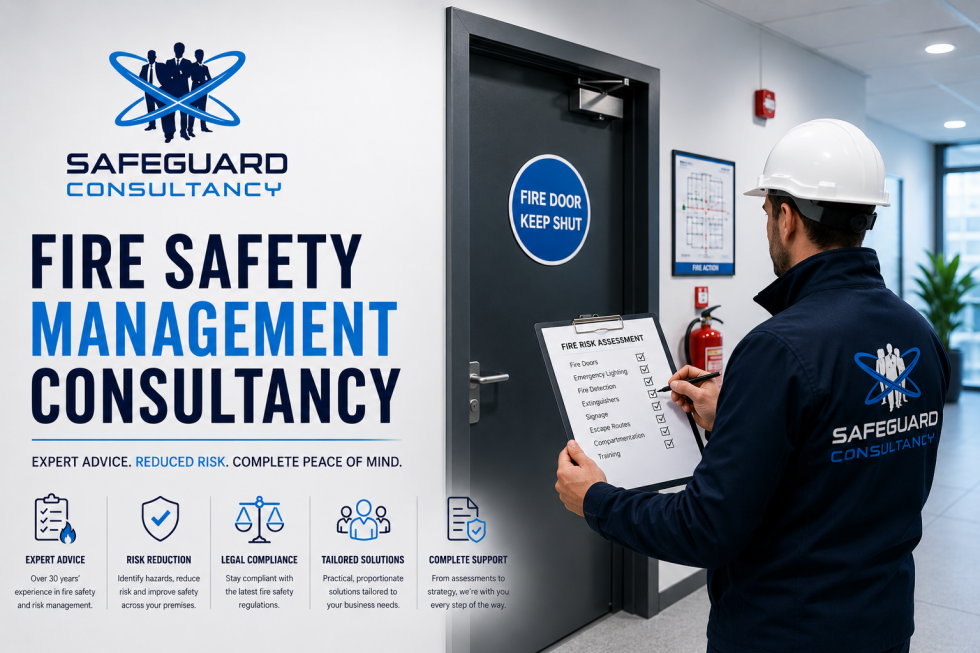
Fire safety management brings a building's people, policies, technical measures and records into a coordinated system. Safeguard Consultancy provides nationwide support to help organisations connect those elements, with services spanning assessments, fire strategies, surveys, evacuation planning and training.
The consultancy works with owners, landlords, responsible persons and senior managers across single buildings and property portfolios. Its approach is tailored to the type of premises, occupancy and risk profile, drawing on more than 30 years of experience in commercial, industrial, residential, education, care and healthcare settings.
A management framework rather than a single report
An assessment or inspection provides important information, but ongoing management requires that information to be acted upon. Policies, responsibilities, maintenance arrangements, procedures and review programmes need to work together. Safeguard supports the development of a framework that can be used by the people managing the premises day to day.
The service covers both active measures, such as detection, alarms, emergency lighting and smoke control, and passive protection, including compartmentation, doors and fire-stopping. Findings from these areas can be brought into risk registers and maintenance plans, giving managers a more coherent basis for decisions and budgets.
Documentation supports that system. Assessment reports, survey evidence, strategies, evacuation plans and maintenance records need to remain consistent with one another and with the building. Clear version control and a recorded history of decisions make it easier to manage change and provide evidence for governance, audits and relevant building-safety requirements.
Assessment and review programmes
Safeguard carries out fire risk assessments for residential buildings, student accommodation, commercial premises, care settings, education and industrial facilities. These identify hazards, people at risk and the control measures in place, with findings translated into prioritised recommendations.
Follow-up support can help an organisation plan remedial work, maintain registers and arrange re-inspections. For larger portfolios, a risk-based programme can provide consistency across sites while allowing the level of investigation and review to reflect differences in buildings and occupancy. The aim is to keep assessments useful as circumstances change.
Connect design intent with occupation
For new buildings, refurbishments and more unusual premises, Safeguard provides fire strategy development and fire engineering support. Strategies bring together means of escape, compartmentation, active and passive protection, detection and management responsibilities. They provide the design context against which operational arrangements can be developed.
Where prescriptive guidance does not adequately address a project, fire engineering can examine alternative solutions. Safeguard references BS 7974 and associated guidance where appropriate, alongside the relevant building requirements and sector context. The management system then needs to reflect the assumptions and responsibilities established by the strategy.
That connection is important at handover and after alterations. Drawings, specifications and commissioning information have practical value only when the operating team can use them to understand the building, maintain its protection and manage future changes. Safeguard helps align strategy and operational documentation rather than treating them as separate exercises.
Verify the condition of protective measures
Passive protection depends on the condition and continuity of the installed construction. Compartmentation surveys can identify defects and uncertainty, supported by photographs, location references and prioritised findings. These outputs can inform remedial specifications, risk registers and the information retained about the building.
Fire door inspections examine doorsets and their condition, while broader fire safety condition surveys give a view of accessible compartment lines, alarms, detection, emergency lighting, signage and supporting documentation. Different survey types answer different questions, so the scope should match the issue being investigated rather than assume every inspection provides the same depth of information.
Safeguard also advises on fire-stopping survey requirements and how findings can be incorporated into a wider improvement programme. Bringing the survey evidence into the management framework helps teams plan repairs and retain a clearer record of decisions and completion.
Make evacuation arrangements usable
Evacuation plans need to turn the strategy into practical instructions. Roles, escape routes, assembly points and arrangements for vulnerable occupants should be clear to the staff who will implement them. Safeguard prepares and reviews plans for different occupancies, linking them to the building's strategy, compartmentation evidence and training.
The plans should work with the organisation's actual staffing and building use. Reviewing them alongside assessments and survey findings helps identify situations in which a change to the building or its occupants also requires a change to procedures. A consistent set of documents is easier to brief, rehearse and maintain.
Support staff knowledge and competence
Safeguard offers online and tutor-led training to support fire safety awareness and people with specific responsibilities. Topics include basic fire safety, fire marshals, doors and extinguishers, with wider health and safety, care and business-skills courses available through Safeguard E-Learning.
The company states that many courses carry approval from recognised bodies such as IOSH, IIRSM and CPD, depending on the course. Training records can contribute to evidence of staff awareness and competence within the management system. Online courses use tutor-led video modules, with the first module available for a free preview.
A structured route from scoping to follow-up
Work starts with a discussion of the buildings, occupants, existing arrangements and objectives. Sector-specific context, including healthcare and education guidance where relevant, helps define the scope. Safeguard then reviews available assessments, strategies, plans, maintenance records and previous surveys to identify the starting point and gaps in information.
Agreed site work may include assessments, condition surveys, compartmentation inspections or fire door surveys. Reports provide findings and prioritised recommendations, with photographs where appropriate. Those outputs can feed directly into registers, maintenance plans and remedial programmes.
Implementation support can include explaining findings to stakeholders, advising on recommendations and arranging follow-up inspections. Review cycles should reflect risk, building use and significant changes, keeping the management framework responsive to the premises rather than relying solely on a fixed calendar. Safeguard provides support across the UK for organisations seeking a consistent approach with room for site-specific requirements.
Source: Safeguard Consultancy
For more information on Professional Fire Safety Management for Safer Buildings talk to Safeguard Fire Consultancy & Training Ltd