 Get Listed

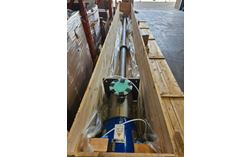
Today, North Ridge Pumps are discussing a recent collaboration they had with the operator of a natural gas terminal in the UK.
The company got in touch with as they were looking to replace an ageing firewater jockey pump, a crucial part of their fire prevention system.
The old unit was a vertical turbine pump which was around 4.9m long and being used to pump firewater from a firewater pond. The pump provided service water and also maintained firewater ring main pressure at 4 bar.
Replacing old design causes problems
The existing pump design from the mid-1980’s was no longer in production. The client wanted to replace this with a new unit that matched the existing pump dimensions and footprint to minimise the civil works needed at the terminal.
As assets age and wear out, their designs are often simply updated. However, it’s not just a case of switching out the old model for the new one.
When civil work is required to fit an updated pump design it can cause a whole range of issues on site. Even more so when it’s a gas terminal like this where any equipment used must be ATEX certified and on-site hot work is strictly prohibited.
In effect, if any pipework modifications are necessary in a ATEX zone like this it would probably mean that work would have to be carried out off-site or during a planned or enforced plant shutdown.
Why is a firewater jockey pump so important?
Obviously, fire protection systems are critical for any business wishing to safeguard lives, property and assets.
Many key components work together to ensure that these systems operate reliably at all times. But the jockey pump, also known as a pressure maintenance pump or make-up pump plays one of the most vital roles.
While the large fire pumps are at the heart of the fire safety infrastructure, the jockey pump makes sure that these main pumps only operate when actually needed.
Here’s why a jockey pump is essential in a fire protection system:
1. Protects the main fire pump
Without a jockey pump, even a tiny leak could cause the main fire pump to activate repeatedly as it is pressure activated – working when a pressure drop is detected. Constant short cycling like this can wear out components, increase energy consumption and reduce the main pump’s operational lifespan.
2. Ensures system reliability
By keeping water pressure at the required level, jockey pumps ensure that the fire protection system remains fully pressurised at all times. If a fire ever breaks out, this reliability can be the difference between an immediate response at full pressure and a dangerous delay in the system kicking in and fighting the fire.
3. Cost-effective operation
As jockey pumps are smaller and more efficient, they can maintain pressure at a fraction of the energy cost of a main pump. Over the long term, this can produce significant savings and help extend the life of the main fire pump.
4. Compliance with standards
Firewater jockey pumps in the UK must be certified as able to maintain system pressure to prevent unnecessary main fire pump starts. They must meet BS EN 12845 which specifies requirements and gives recommendations for the design, installation and maintenance of fixed fire sprinkler systems in buildings and industrial plants.
Pumps may also be required to comply with NFPA 20, the Standard for the Installation of Stationary Pumps for Fire Protection. This standard regulates the design, selection and installation of fire pumps to ensure water supply reliability.
So what is a firewater jockey pump and how does it work?
It’s a small, high-pressure, low-flow centrifugal pump usually of multistage design used specifically to maintain pressure within the piping network.
Key features of jockey pumps
1. Monitoring system pressure
The jockey pump is controlled by pressure switches, so that when the overall system pressure drops below a preset level, the jockey pump automatically kicks in to restore it.
2. Making up for minor losses
Small leaks, water evaporation, system testing or regular maintenance activity can cause minor drops in system pressure which the jockey pump automatically rectifies. Without this pump, these minor losses would continuously trigger the main fire pump, leading to unnecessary wear and tear.

Maintaining constant readiness
By keeping pressure consistent, the jockey pump ensures that when a sprinkler or hydrant is activated during a real fire emergency, the main fire pump will start at the optimum performance level. It works automatically based on pressure switches that spot when pressure drops below a preset level. Once full pressure is restored, the jockey pump switches off automatically.
Unlike the main fire pump, which is designed to deliver large volumes of water during emergencies, the jockey pump is not intended to fight fires directly.
Instead, it keeps the fire protection system primed and ready so that when a fire occurs, the main fire pump activates immediately at full power. It also minimises false alarms and unnecessary system stress.
The best pump for the job
As the UK’s biggest pump supplier with over 25 years successful trading in this sector, North Ridge Pumps have proven expertise at specifying pumps for a wide range of applications. We use our expert knowledge to give each client a bespoke solution, not a standard pump product picked off the shelf.
What’s more, we can select the best pump for every job – offering the lowest lifetime cost. Unlike some pump manufacturers, we’re not restricted to just one type of pump or pump technology.
What did we specify for this project?
To start the specification process, we began by carefully reviewing the client’s Piping and Instrumentation Diagram (P&ID) drawings, pump specification sheets and existing pump drawings.
We then came up with a couple of tailored options which would deliver the client’s required flow and pressure of 40m³/h at 4.7 bar for their fire main jockey pump.
The final option which we progressed was a 4.9m XVT vertical immersion turbine pump designed in line with ISO5299 standards. This is an immersed mixed flow pump able to handle clean or contaminated water from untreated industrial sources, rivers, lakes or dams.
All of the pump components were made from 316 stainless steel including the suction bowl, impellers, shaft, column and discharge head outlet.
The pump was also fabricated with 4” ANSI 150lb flanges to match the existing pipework connections and foundations.
Due to the ATEX zoning, we provided the 3-stage vertical immersion pump complete with a 15Kw EExd Zone 1 T3 IIA ATEX motor operating at two pole speed of 2,900rpm to deliver the main pressure required of 4 bar with 4” outlet.
Careful consideration of immersion depth
With vertical turbine pumps like this, we always have to pay close attention to the minimum immersion depth. That’s because there’s a balance to be struck between the pump performance demanded and the NPSH available.
The NPSH or Net Positive Suction Head is the minimum pressure required at a pump's suction side to ensure proper operation.
For this particular application, we calculated that we could handle a minimum submergence of 0.24m or 24cm whilst still delivering the required duty point. This would guarantee that the jockey pump would still operate even if the water source levels became low.
Finally, we supplied the 3-stage vertical immersion pump complete with 3.1 material certification, along with an on-site witness performance test which confirmed the required duty point before we despatched the pump.
If your company needs pumps capable of consistent, high-pressure operation in critical or hazardous conditions.North Ridge Pumps
For more information on Vertically immersed Multistage jockey pump for fire protection system talk to North Ridge Pumps Ltd