 Get Listed
Sign In


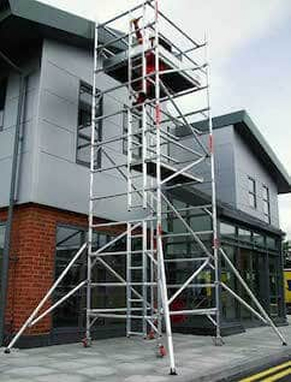
Data and communications cabling work regularly takes installers above suspended ceilings, along service routes and through areas where space is limited. A suitable scaffold tower needs to give safe access to cable trays, containment, wireless access points and ceiling voids while still being easy to reposition as the installation progresses.
Choosing a tower for cable routes
Cabling projects are rarely carried out from one fixed position. Installers may work along corridors, across open-plan offices or through several adjoining rooms, so mobility is particularly important. Towers with lockable castors allow the working platform to be moved between positions without repeated dismantling, provided the tower is moved in accordance with the manufacturer's guidance and nobody remains on the platform during repositioning.
Mi Tower for single-person installations
A compact Mi Tower is well suited to a single engineer carrying out lighter cabling work at normal commercial ceiling heights. It gives enough platform space for hand tools and smaller reels or components without taking up too much floor area. The ability for one trained operative to assemble the tower also makes it useful for smaller installation and maintenance teams.
Narrow towers for corridors and comms areas
Data and communications cabling often follows corridors, risers and back-of-house routes where a full-width tower would be awkward. Narrow towers are particularly useful in these situations, allowing installers to work close to containment while keeping more of the route clear for other trades and building users.
AGR towers for larger installations
Where two engineers need to work together, or where larger cable trays and containment are being installed, a wider AGR tower provides additional deck space and load capacity. The extra room makes it easier to organise tools and fixings without crowding the platform.
Working around electrical services
Comms installers frequently work close to power cabling, lighting circuits and other electrical services. Where there is a genuine electrical risk, a GRP tower can provide a non-conductive access solution. The work area should still be assessed properly and services isolated wherever possible.
Before hiring, measure the structural working height rather than relying only on the finished ceiling level. Cable routes often sit above suspended ceilings, so the platform needs to position the installer comfortably at the actual tray or containment height. Matching the tower to the route, access restrictions and crew size will make the installation safer and considerably more efficient.
Choosing a tower for cable routes
Cabling projects are rarely carried out from one fixed position. Installers may work along corridors, across open-plan offices or through several adjoining rooms, so mobility is particularly important. Towers with lockable castors allow the working platform to be moved between positions without repeated dismantling, provided the tower is moved in accordance with the manufacturer's guidance and nobody remains on the platform during repositioning.
Mi Tower for single-person installations
A compact Mi Tower is well suited to a single engineer carrying out lighter cabling work at normal commercial ceiling heights. It gives enough platform space for hand tools and smaller reels or components without taking up too much floor area. The ability for one trained operative to assemble the tower also makes it useful for smaller installation and maintenance teams.
Narrow towers for corridors and comms areas
Data and communications cabling often follows corridors, risers and back-of-house routes where a full-width tower would be awkward. Narrow towers are particularly useful in these situations, allowing installers to work close to containment while keeping more of the route clear for other trades and building users.
AGR towers for larger installations
Where two engineers need to work together, or where larger cable trays and containment are being installed, a wider AGR tower provides additional deck space and load capacity. The extra room makes it easier to organise tools and fixings without crowding the platform.
Working around electrical services
Comms installers frequently work close to power cabling, lighting circuits and other electrical services. Where there is a genuine electrical risk, a GRP tower can provide a non-conductive access solution. The work area should still be assessed properly and services isolated wherever possible.
Before hiring, measure the structural working height rather than relying only on the finished ceiling level. Cable routes often sit above suspended ceilings, so the platform needs to position the installer comfortably at the actual tray or containment height. Matching the tower to the route, access restrictions and crew size will make the installation safer and considerably more efficient.
For more information on Best Scaffold Towers for Data and Comms Cabling: Hire Guide talk to Lakeside Hire
Welcome back to FindTheNeedle.
Not registered? Get listed — most visitors don't have an account yet.
List your company on FindTheNeedle.