 Get Listed

Small Bottle Filling
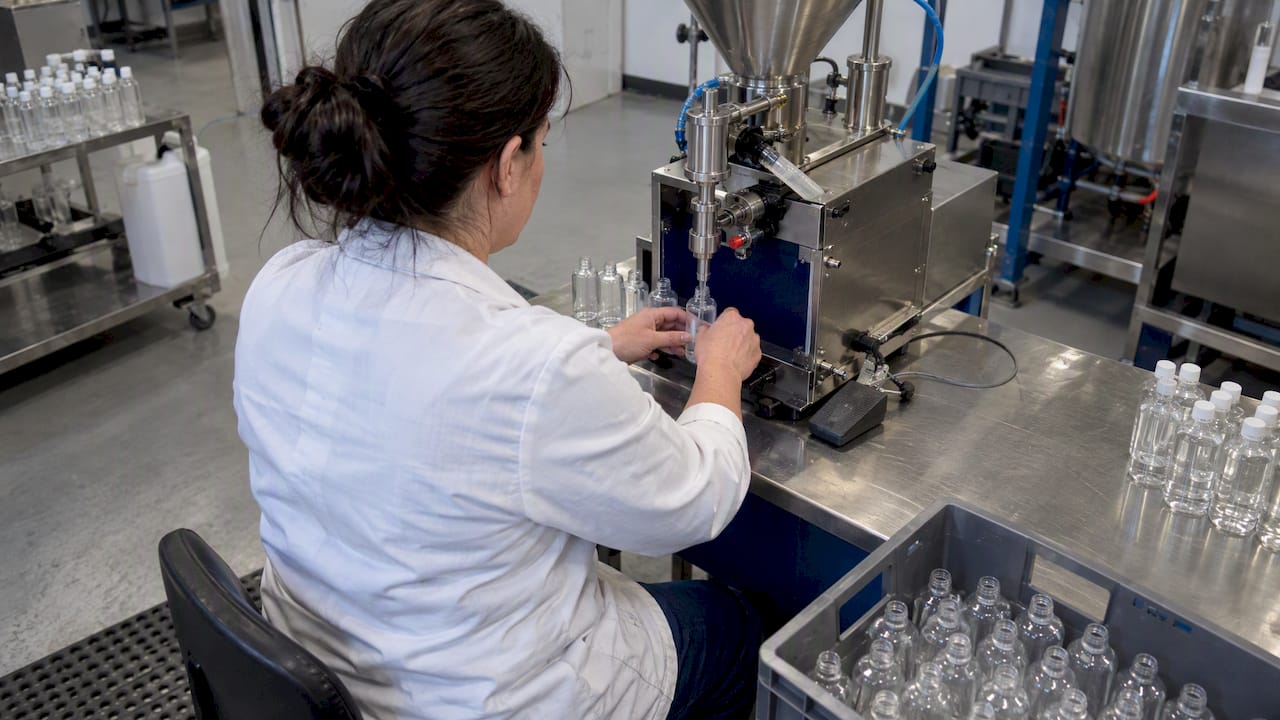
Selecting equipment for small bottle filling begins with the liquid, bottle and batch, rather than the largest machine a business can afford. KBW Packaging's guide examines how manufacturers can move from hand filling to a more repeatable process while retaining flexibility for different products and future growth.
Small bottle work can describe three different challenges: a small container needing precise dosing, a short production run needing quick changeovers, or a small business balancing labour, space and investment. A useful specification needs to reflect whichever combination applies.
Describe the job before comparing models
Dropper bottles, sample containers and small cosmetic or supplement packs can make a small absolute error significant as a proportion of the dose. Short runs introduce a different concern: cleaning and adjustment may take longer than filling. For a small team, one person tied to a filling bench can also restrict the rest of production.
Warning signs that manual filling is becoming a constraint include inconsistent levels, product spillage, excessive rework and long periods of repetitive operator handling. Measuring those losses gives a more useful basis for investment than comparing machine speeds without context.
KBW asks customers to describe viscosity, foaming, particles, chemical compatibility and filling temperature. Thin liquids behave differently from oils, lotions, gels and sauces; seeds or pulp need suitable passages; alcohol or essential oils may affect seals. Cleaning between products is another part of the specification.
Free-flowing liquids can suit volumetric or level-based systems. Thicker formulations may require a positive-displacement process that actively moves product through the machine. Suppliers should assess the actual material and containers rather than assume a water demonstration represents the production task.
Understand the operator's role
With semi-automatic machinery, an operator normally positions the bottle, triggers the dose and removes the filled pack. This can suit short runs, varied products and compact production areas. An automatic machine uses container handling and sensing to move bottles through the filling stage, reducing the need to place each one manually.
Automatic systems can be appropriate for repeat runs, but changeovers require attention to guides, nozzles, sensors and conveyor space. A well-used semi-automatic filler may provide a better fit than an automatic line operated only occasionally.
The decision should be tested against expected demand over the next two years. Calculate operator hours as well as units, including loading, cleaning and changing formats. This helps show when hand-fed bottles are likely to become the limiting factor.
KBW's examples for shorter runs include the AF0010 and volumetric AF0020. The AF0080 and AF0120 are among its automatic options for higher requirements. Configuration and pricing depend on the individual application, so a product-specific quotation is needed.
Test accuracy at the intended fill
An accuracy statement needs three pieces of context: the volume being filled, the product used in testing and the length of the test. A small variation on a large bottle can become material on a small vial. Results with water do not necessarily transfer to a foaming wash or a stringing gel.
Performance can also change during a run as product temperature, hopper level and component condition vary. KBW suggests testing a sample run with the real product, recording individual results and checking the spread rather than looking only at a few successful first fills.
The guide gives 20–30 bottles as a practical initial trial sample. The purpose is to establish repeatability at the relevant smallest dose and operating conditions, not to replace the business's full quality-control plan. The production team should agree the measurement method and acceptance criteria for its own products.
Connect filling accuracy with quality control
Pack quantity and label information need to agree. Businesses should confirm the applicable quantity-control arrangements and records with current government guidance or Trading Standards. Both minimum and average systems exist, so an average-system requirement should not be assumed to be the only route for every pack.
Food, medicine and cosmetic businesses also need to consider their own sector requirements. Quality personnel should be involved when a filling method, container or label changes. Appropriate cleaning, documented operating procedures, traceability and calibration support a controlled process, but purchasing a machine alone does not establish product compliance.
For medicines and other tightly controlled products, installation and performance records may form part of the quality system. Cosmetic businesses should review changes with the people responsible for product safety and manufacturing documentation. The guide points buyers towards specialist and official advice for the details relevant to their products.
Check suitability and safe operation
Equipment needs to suit the intended workplace and task as well as carry the relevant supplier documentation. Guards, interlocks, instructions and emergency arrangements should be checked, and operators trained in starting, stopping, cleaning and changing formats.
KBW's acceptance checklist includes a trial with the actual bottle and liquid, written cleaning and changeover steps, and agreed arrangements for service and spare parts. Any integration with other equipment needs assessment of the resulting line, including transfer points and operator access.
A conformity mark is not a substitute for checking that the equipment is complete, correctly installed and suitable for the way it will be used. The company encourages customers to consider these questions before production begins.
Plan the bottle's route beyond the filler
Once filled, a bottle still needs to be closed and labelled, and may also require a seal. Those stages can become the new constraint if they are left out of the plan. Screw caps, press-on closures and droppers have different handling requirements, so the closure should be specified with the container.
KBW's capping range includes automatic screw and press options. Induction sealing can be considered where an appropriate foil seal is needed. A semi-automatic labeller may provide a practical match for a semi-automatic filler, while accumulation tables can hold containers between operations and help balance an operator's work.
The layout should leave room for these later additions. Bottle height, handling speed, access for cleaning and the way packs move between machines all affect whether a staged investment works efficiently.
Specify for growth and ongoing support
The guide recommends giving the supplier the smallest and largest intended bottles, the full fill range, product samples and realistic weekly volumes. Adjustable parts and suitable nozzles can make later products easier to introduce, but the limits need to be established before purchase.
KBW also highlights installation, training and maintenance as part of long-term performance. Its team can discuss a filler together with capping and labelling requirements, with machinery configured around the application rather than the appearance of the bottle alone.
Source: KBW Packaging
For more information on Small Bottle Filling talk to KBW Packaging Ltd