 Get Listed
Cosmetic Filling Guide
Filling a cosmetic formula successfully depends on the product, its final container and the output required from the production line. KBW Packaging's guide explains how those factors influence the choice of equipment for creams, lotions, gels, serums and other personal care products. It also considers the cleaning, handling and quality checks needed around the filling station.
Define the product before selecting machinery
The starting point is the formula's behaviour. Toners and micellar waters flow readily, while lotions move more slowly and rich creams or balms may need positive displacement or temperature-controlled handling. Exfoliating particles, glitter and other inclusions can require wider passages and different valves. Alcohol, acidity and essential oils also influence the compatibility of seals and product-contact materials.
Foaming, entrained air and filling temperature should be discussed alongside viscosity. A freshly mixed product may behave differently from one that has settled, and a balm filled warm may begin setting in pipework. Suppliers also need the complete fill range: a 15ml serum and a 500ml shampoo create different dosing and nozzle requirements.
KBW recommends trials with the actual formula and samples of the intended packaging. Results obtained with water or a similar-looking container do not establish how a production product will run.
Match the filling principle to the formula
Free-flowing products may suit gravity or volumetric equipment. A volumetric machine meters a set dose for each cycle rather than relying on the appearance of the liquid level. KBW identifies its AF0020 as an example within this category.
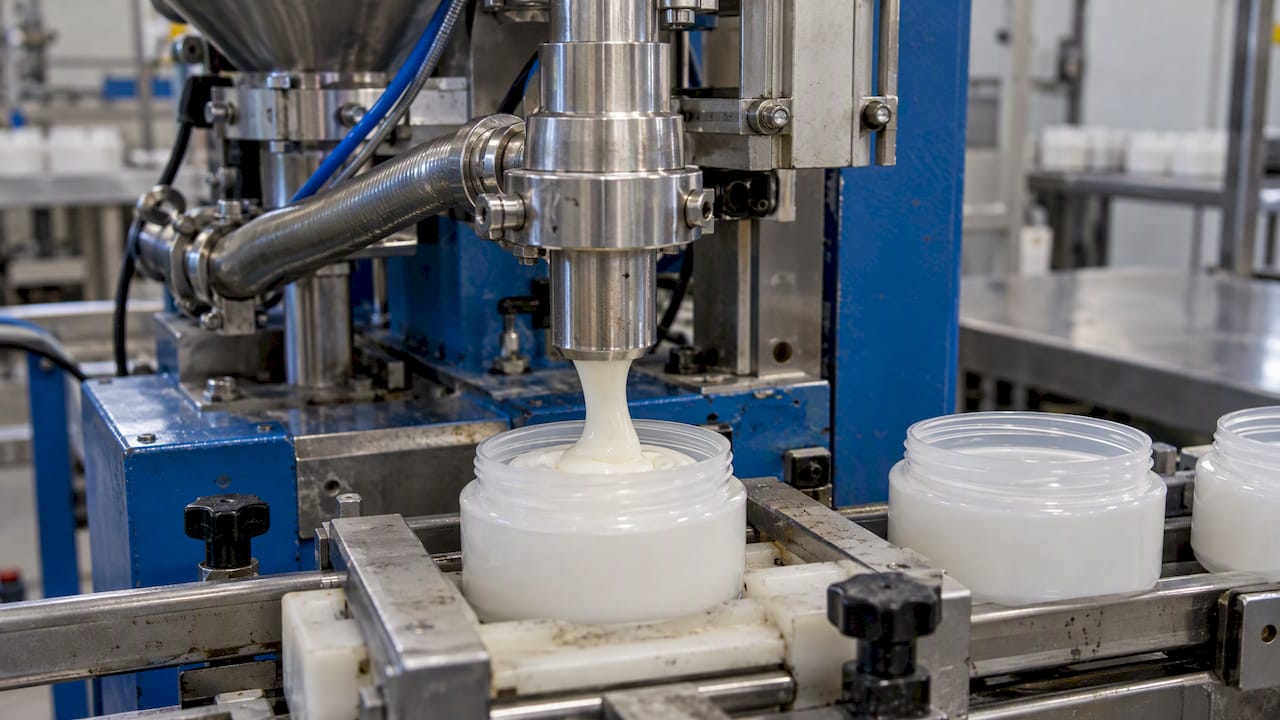
Piston fillers draw product into a cylinder and discharge it through a nozzle. This helps move creams, gels and other products that do not flow readily under gravity. Adjustable strokes and suitable nozzles can accommodate different fills, although the full range must be confirmed with the supplier. Very thick products may also need an appropriate hopper or heating arrangement.
Medium-viscosity liquids such as lotions, shampoos and some serums sit between these categories. Air bubbles, stringing and the way a nozzle cuts off can be as important as the nominal dose. There is no universal viscosity boundary that replaces testing the individual formulation.
Choose the right level of automation
Semi-automatic equipment leaves container placement and cycle initiation with an operator, often using a foot pedal. It can suit new brands, short runs and frequent format changes. Automatic equipment moves containers through the filling position with less manual handling and can be appropriate when demand becomes more consistent.
KBW's examples include the semi-automatic AF0010 and automatic AF0040 and AF0080. The decision should reflect staffed hours, cleaning and changeovers as well as bottles per minute. Equipment that can work alongside future capping and labelling machinery provides a clearer route for expansion.
Consider the container and closure
Narrow bottle necks constrain nozzle diameter and filling speed. With foaming liquids, nozzle travel and discharge position also need attention. Jars and pots offer easier access but expose the surface finish, making a clean cut-off and an even presentation important.
Tubes normally require a separate filling and sealing process. Airless pumps and specialised packs may have specific filling arrangements that should be confirmed with their supplier. Glass, PET, HDPE and polypropylene containers also respond differently to closure torque, heat and label application.
Trials should therefore use containers from the intended production supplier. Small dimensional variations can affect centring, cap seating and sealing. The closure, pump or lid needs to be considered at the same time as the bottle or jar.
Plan the complete line
The normal sequence includes presenting containers, dosing product, applying closures, adding any required seal and then labelling and coding. A filler working well in isolation can still feed into a bottleneck at the next station.
Accumulation or rotary tables can buffer containers and help maintain a steady flow. Capping equipment needs to match screw, press-on or pump closures, with controlled application that protects both pack and contents. Induction sealing can provide a foil liner where appropriate. Labelling equipment must handle the container shape and maintain a consistent finish.
KBW illustrates the planning issue with a business producing 2,000 weekly units of a 50ml cream. Semi-automatic filling, bench capping and labelling may be a practical starting point, but a later increase in demand may justify upgrading a downstream station before replacing the filler. Adding a 200ml lotion and a 15ml serum introduces a further question: whether one machine can cover the whole range efficiently.
Cleaning between strongly coloured and clear products can also consume production time. In some operations, dedicating equipment to a product family may be preferable to repeated complex changeovers.
Build cleaning and traceability into the process
Accessible product-contact parts, suitable cleaning methods, controlled production access and batch identification are central to the guide. Staff need training in dismantling, cleaning and reassembly so that hygiene work does not introduce new contamination or dosing problems. Records should show what was cleaned and checked for each batch.
The guide also places machinery within the wider cosmetics compliance process. Product safety assessment, the Responsible Person and the Product Information File are separate from the purchase of a filler. Businesses should confirm their product-specific obligations with their safety assessor and current official guidance rather than treating machinery as proof of compliance.
Diagnose problems across the system
Variable fill weights may involve air, worn seals or viscosity changes as the product warms. Strings and drips may require changes to nozzle design, cut-off or filling motion. Dirty bottle threads can indicate poor alignment and can then affect capping and sealing. Foam and air pockets should be investigated at the product supply stage as well as at the nozzle.
KBW's purchasing checklist includes product characteristics, future pack sizes, realistic output, trial results, cleaning time, changeover arrangements and the spares needed. Installation, operator training and ongoing maintenance should be agreed before the line enters service. The company can discuss filling, capping and labelling equipment around a customer's samples, space and growth plans.
Source: KBW Packaging
For more information on Cosmetic Filling Guide talk to KBW Packaging Ltd