

» External gear pumps are hydraulic machines converting mechanical power into hydraulic power.
» External gear motors are hydraulic machines converting hydraulic power into mechanical power.
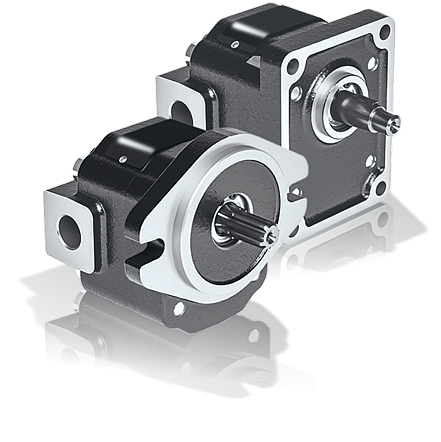
Available now are these cast iron bodied, cast iron flanged gear pumps and gear motors for applications requiring high pressures, optimal performance and endurance. The latest addition to the reliable, precisely engineered Marzocchi Pompe range.
Links to sections of this page:
 Get Listed
Sign In
CAST IRON GEAR PUMPS & MOTORS
29-04-2025
jbj Techniques Limited, official UK distributor for Marzocchi Pompe S.p.A.
Frequently Used Mathematical Formulas ~ Gear Pumps
These are some of the criteria to consider when deciding which size gear motor is needed for an application.
Fluid velocity:
Calculate the velocity (v) of a fluid in a pipe as follows:
v =Q / 6 • A[m/s]
Q = flow rate [litre/min]
A = inside area of pipe [cm²]
Absorbed flow rate:
Calculate flow rate (Q) as follows:
Q = (V • n • 10 -3) ÷ hvol [litre/min]
V = displacement [cm³/rotation].
n = rotation speed [rotations per minute].
hvol = motor volumetric efficiency (take 0.95 as an indicative value for rotation speeds ranging between 1000 and 2000 rotations per minute).
Absorbed torque:
Calculate necessary torque (M) of a pump subject to pressure differential between inlet and delivery as follows:
M= (V • Dp) / (62.8 • hhm) [Nm]
V = displacement [cm³/rotation].
Dp = pressure differential [bar].
hhm = hydromechanical efficiency (take 0.80 as indicative value under cold conditions and 0.85 under working conditions).
Absorbed power:
Calculate hydraulic power (P), delivered by a pump subject to a pressure differential between input and output as follows:
P= (Q • Dp) / (600 •htot) [kW]
Q = flow rate [litre/min.].
Dp = pressure differential [bar].
htot = total motor efficiency (hhm • hvol).
Values for hvol and hhm (and consequently htot) depend on pressure differential between supply and delivery, rotation speed, fluid features (temperature and viscosity) and filtering degree.
Contact jbj Techniques technical office, email: info@jbj.co.uk or telephone: +44 (0)1737 767493 for further details on efficiency.
Fluid velocity:
Calculate the velocity (v) of a fluid in a pipe as follows:
v =Q / 6 • A[m/s]
Q = flow rate [litre/min]
A = inside area of pipe [cm²]
Absorbed flow rate:
Calculate flow rate (Q) as follows:
Q = (V • n • 10 -3) ÷ hvol [litre/min]
V = displacement [cm³/rotation].
n = rotation speed [rotations per minute].
hvol = motor volumetric efficiency (take 0.95 as an indicative value for rotation speeds ranging between 1000 and 2000 rotations per minute).
Absorbed torque:
Calculate necessary torque (M) of a pump subject to pressure differential between inlet and delivery as follows:
M= (V • Dp) / (62.8 • hhm) [Nm]
V = displacement [cm³/rotation].
Dp = pressure differential [bar].
hhm = hydromechanical efficiency (take 0.80 as indicative value under cold conditions and 0.85 under working conditions).
Absorbed power:
Calculate hydraulic power (P), delivered by a pump subject to a pressure differential between input and output as follows:
P= (Q • Dp) / (600 •htot) [kW]
Q = flow rate [litre/min.].
Dp = pressure differential [bar].
htot = total motor efficiency (hhm • hvol).
Values for hvol and hhm (and consequently htot) depend on pressure differential between supply and delivery, rotation speed, fluid features (temperature and viscosity) and filtering degree.
Contact jbj Techniques technical office, email: info@jbj.co.uk or telephone: +44 (0)1737 767493 for further details on efficiency.
Information required to select the right size Hydraulic Gear Pump . . .
There are several factors that need to be known before a calculation can be used to decide the most suitable sized hydraulic gear pump for an application:
1) Application details – driving speed.
2) Required flow (l/min).
3) Required continuous pressure (bar). Required peak pressure. Required 'spike' pressure.
4) Details of the oil type and viscosity. System operating temperature. Cold start temperature.
5) Required output shaft and mounting flange.
6) Required port connections.
7) Check the motor power required.
8) Don’t forget the bellhousing and coupling from the electric motor or engine to the hydraulic gear pump. jbj Techniques have a wide range of mechanical power transmission couplings to suit many applications. We would be happy to help.
1) Application details – driving speed.
2) Required flow (l/min).
3) Required continuous pressure (bar). Required peak pressure. Required 'spike' pressure.
4) Details of the oil type and viscosity. System operating temperature. Cold start temperature.
5) Required output shaft and mounting flange.
6) Required port connections.
7) Check the motor power required.
8) Don’t forget the bellhousing and coupling from the electric motor or engine to the hydraulic gear pump. jbj Techniques have a wide range of mechanical power transmission couplings to suit many applications. We would be happy to help.
Frequently Used Mathematical Formulas ~ Gear Motors
These are some of the criteria to consider when deciding which size gear motor is needed for an application.
Fluid velocity:
Calculate the velocity (v) of a fluid in a pipe as follows:
v = Q ÷ (6 • A [m/s])
Q = flow rate [litre/min]
A = inside area of pipe [cm²]
Absorbed flow rate:
Calculate flow rate (Q) as follows:
Q = (V • n • 10 -3) ÷ hvol [litre/min]
V = displacement [cm³/rotation].
n = rotation speed [rotations per minute].
hvol = motor volumetric efficiency (take 0.95 as an indicative value for rotation speeds ranging between 1000 and 2000 rotations per minute).
Delivered torque:
Calculate necessary torque (M) of a motor subject to pressure differential between input and output as follows:
M = (V • Dp • hhm) ÷ 62,8 [Nm]
V = displacement [cm³/rotation].
Dp = pressure differential [bar].
hhm = hydromechanical efficiency (take 0.80 as indicative value under cold conditions and 0.85 under working conditions).
Delivered power:
Calculate hydraulic power (P), delivered by a motor subject to a pressure differential between input and output as follows:
P = (Q • Dp • htot) ÷ 600 [kW]
Q = flow rate [litre/min.].
Dp = pressure differential [bar].
htot = total motor efficiency (hhm • hvol).
Values for hvol and hhm (and consequently htot) depend on pressure differential between supply and delivery, rotation speed, fluid features (temperature and viscosity) and filtering degree. Contact jbj Techniques technical office, email: info@jbj.co.uk or telephone: +44 (0)1737 767493 for further details on efficiency.
Fluid velocity:
Calculate the velocity (v) of a fluid in a pipe as follows:
v = Q ÷ (6 • A [m/s])
Q = flow rate [litre/min]
A = inside area of pipe [cm²]
Absorbed flow rate:
Calculate flow rate (Q) as follows:
Q = (V • n • 10 -3) ÷ hvol [litre/min]
V = displacement [cm³/rotation].
n = rotation speed [rotations per minute].
hvol = motor volumetric efficiency (take 0.95 as an indicative value for rotation speeds ranging between 1000 and 2000 rotations per minute).
Delivered torque:
Calculate necessary torque (M) of a motor subject to pressure differential between input and output as follows:
M = (V • Dp • hhm) ÷ 62,8 [Nm]
V = displacement [cm³/rotation].
Dp = pressure differential [bar].
hhm = hydromechanical efficiency (take 0.80 as indicative value under cold conditions and 0.85 under working conditions).
Delivered power:
Calculate hydraulic power (P), delivered by a motor subject to a pressure differential between input and output as follows:
P = (Q • Dp • htot) ÷ 600 [kW]
Q = flow rate [litre/min.].
Dp = pressure differential [bar].
htot = total motor efficiency (hhm • hvol).
Values for hvol and hhm (and consequently htot) depend on pressure differential between supply and delivery, rotation speed, fluid features (temperature and viscosity) and filtering degree. Contact jbj Techniques technical office, email: info@jbj.co.uk or telephone: +44 (0)1737 767493 for further details on efficiency.
Information required to select the right size Hydraulic Gear Motor . . .
There are several factors that need to be known before a calculation can be used to decide the most suitable sized hydraulic gear motor for an application:
1) Application details – driving speed, reversing, shocks, shaft loading, etc.
2) Required running and starting torque values (Nm).
3) Details of the oil type and viscosity.
4) Cold start temperature.
5) Required output shaft and mounting flange.
6) Required port connections.
7) What flow and pressure is available? Check against the oil flow and pressure that the selected motor requires.
8) Don’t forget the coupling from the hydraulic motor shaft to the driven shaft. jbj Techniques have a wide range of mechanical power transmission couplings to suit many applications. We would be happy to help.
1) Application details – driving speed, reversing, shocks, shaft loading, etc.
2) Required running and starting torque values (Nm).
3) Details of the oil type and viscosity.
4) Cold start temperature.
5) Required output shaft and mounting flange.
6) Required port connections.
7) What flow and pressure is available? Check against the oil flow and pressure that the selected motor requires.
8) Don’t forget the coupling from the hydraulic motor shaft to the driven shaft. jbj Techniques have a wide range of mechanical power transmission couplings to suit many applications. We would be happy to help.
Overall physical size can often be an important consideration. Available flow to the gear motor from the system can determine whether a small motor at high pressure is used or a larger motor at low pressure. A larger motor at lower pressure will achieve longer life but a lack of space available may determine that a smaller motor is used.
Controlling the speed of the gear motor is another requirement depending on the application.
Please contact jbj Techniques technical office for further details and help to choose the correct size gear motor for your application, email: info@jbj.co.uk or telephone: +44 (0)1737 767493
Controlling the speed of the gear motor is another requirement depending on the application.
Please contact jbj Techniques technical office for further details and help to choose the correct size gear motor for your application, email: info@jbj.co.uk or telephone: +44 (0)1737 767493
Group 4 models to be released soon!
A range of mounting flanges, output shafts, and ports are available to suit a variety of applications. See the technical specification catalogue for further details of this latest range of cast iron external gear pumps and gear motors.
A range of mounting flanges, output shafts, and ports are available to suit a variety of applications. See the technical specification catalogue for further details of this latest range of cast iron external gear pumps and gear motors.
We hope that this is of help but feel free to contact the jbj Techniques technical office, email: info@jbj.co.uk or telephone: +44 (0)1737 767493 if you need assistance or have further questions.
Application example
An example of the use of a gear motor using fluid power from the hydraulic system of an agricultural machine, heavy plant industrial machine, off-shore marine vessel, heavy goods vehicle or public service vehicle to create rotary mechanical power. In this case to power three hydraulic gear pumps for additional hydraulic systems on the machine.
Products, technical expertise and service for you . . .
A range of couplings, bellhousings and power take-off units are also available from jbj Techniques as is the technical expertise and back-up, plus skilled machine shop services to supply drive line packages for a wide range of industrial, agricultural, heavy plant and marine applications.
Check the product list for full range of quality products for mechanical and fluid power.
Check the product list for full range of quality products for mechanical and fluid power.
Here to help you . . .
High quality mechanical and fluid power products are always available straight from our comprehensively stocked warehouse, but, we are more than that! If you need more, be it the smallest drive component through to complex drive line component packages, then speak to our experienced sales team who will provide a solution based upon your application requirements. For example . . .
For more information on CAST IRON GEAR PUMPS & MOTORS talk to jbj Techniques Limited
Enquire Now
List your company on FindTheNeedle.