 Get Listed
In high risk industries, consistency and clarity in technical guidance are critical. Engineers and inspectors working in hazardous areas should not only understand legislation and standards such as ATEX and IECEx, but
also how they apply within their organisation’s specific operational context.
While industry guidance provides a strong foundation, many organisations face a common challenge: bridging the gap between global standards and internal procedures.
This is where tailored technical guidance can make a measurable difference.
Why Standard Guidance Isn’t Always Enough
Publicly available guidance documents are designed to be broadly applicable across industries and asset types. However, no two organisations operate in exactly the same way.
Differences in:
- Asset configurations
- Inspection regimes
- Maintenance strategies
- Internal risk management processes
Mean that engineers are often required to interpret how generic guidance applies to their day-to-day responsibilities.
This can introduce inconsistency, increase the likelihood of misinterpretation, and ultimately impact compliance and safety performance.
Adapting the EPIT Yellow Book to Your Operations
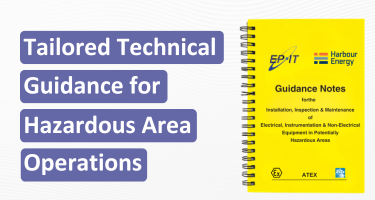
The EPIT Yellow Book is widely used as a practical reference for the installation, inspection, and maintenance of equipment in hazardous areas. It provides clear, structured guidance aligned with recognised international standards.
However, it can also be adapted.
EPIT works with organisations to develop customised editions of the Yellow Book that incorporate company specific procedures, inspection requirements, and operational guidance. This ensures that personnel are not switching between multiple documents or interpreting how internal processes align with legislation and standards.
Instead, they have a single, coherent reference point.
A Practical Example: Collaboration with Harbour Energy
A recent example of this approach is EPIT’s collaboration with Harbour Energy.
In this project, a bespoke version of the Yellow Book was developed to align with Harbour Energy’s internal standards and operational practices. As part of this, an additional section on Defect Management and Criticality Ranking was introduced.
This section provides:
- Clear guidance on identifying and categorising defects
- Defined inspection requirements based on criticality
- Structured support for personnel responsible for hazardous area (Ex) equipment
By embedding this level of detail into the guidance document, engineers are better equipped to make consistent, informed decisions in the field.
The Benefits of a Tailored Approach
Customising technical guidance is not simply about convenience, it directly supports safer and more efficient operations.
Organisations that adopt this approach can:
- Integrate internal procedures with industry standards
- Align company specific requirements with recognised certification such as ATEX and IECEx.
- Provide a single source of reference
- Reduce reliance on multiple documents and minimise ambiguity for engineers and inspectors.
- Improve consistency across teams and assets
- Ensure that inspection and maintenance activities are carried out in a uniform way.
- Strengthen compliance and safety performance
- Support better decision making and reduce the risk of non-compliance.
Supporting Competence in Hazardous Areas
In hazardous area operations, competence is built not only through training, but also through access to clear, relevant, and practical guidance.
When engineers are equipped with documentation that reflects legislation, international standards and their organisation’s specific requirements, they are better positioned to carry out their roles safely and effectively.
Tailored guidance helps translate theory into practice, bridging the gap
between compliance and real world application.
Developing Your Own Customised Guidance
The customised Yellow Book developed for Harbour Energy is not commercially available, as it contains client specific information. However, it demonstrates what can be achieved when technical guidance is aligned closely with operational needs.
For organisations operating in hazardous areas, this approach offers a clear opportunity to enhance consistency, improve compliance, and support safer working practices.
If your organisation would benefit from a technical guidance document tailored to your internal standards and procedures, EPIT can work with you to develop a bespoke solution aligned with your operations.
For more information on Tailored Technical Guidance for Hazardous Area Operations talk to EPIT