 Get Listed


White Bullnose Window Board & Sill
Product Code: FBW175W
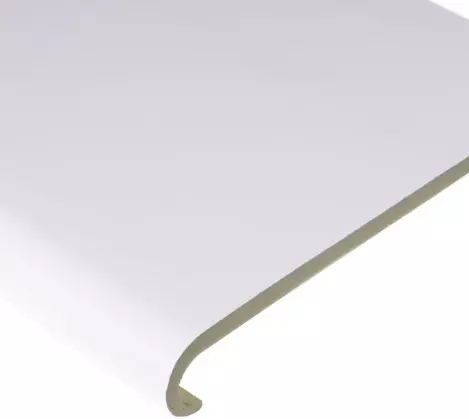
White Bullnose Window Board & Sill – 175mm
The White Bullnose Window Board & Sill is an option when planning window finishing. Selected option: 175mm. Use product code FBW175W when selecting or ordering this item.
The White uPVC Bullnose Window Board is suitable for adding a sleek and contemporary touch to your windows or conservatory. Designed with a beautifully rounded edge, this durable and stylish board complements any room with its clean and modern aesthetic.
Design and features; Attractive round-edge design for a contemporary look; Durable and robust construction ensures long-lasting performance; Low maintenance – never needs painting and is easy to clean; Manufactured by Eurocell, ensuring top-quality craftsmanship; Technical Specifications; Colour: White; Length: 5m; Width:160mm, 180mm, 210mm, 240mm, 260mm and 420mm; Thickness: 10mm.
Colour Fastness: Tested to BS1006 / 1990 Part A03 with a classification of 4 / 5 (minimal colour change)
Fire Rating: Tested to BS476 Part 7:1997 Class 1 surface spread of fire
Thermal Conductivity: Foam profiles 0.07 w/mk; rigid profiles 0.14 w/mk.
Density: Foam profiles 0.55 - 0.6 g/cm³; rigid profiles 1.40 - 1.50 g/cm³
Why would you choose this Window Board?
With its excellent thermal insulation properties, compliance with British Standards (BS EN ISO 9001:2000), and robust build, this uPVC bullnose window board is a reliable and stylish solution for both residential and commercial applications. Its timeless white finish coordinates with any décor, making it suitable for homeowners and installers.
Before ordering, inspect the opening and measure the sill or window board at several points. Walls and reveals are not always square, especially in refurbishment work. Take account of any projection beyond the wall, the depth beneath the window and the way the ends will meet the surrounding finish. Use those measurements to establish the appropriate profile and cutting allowance.
Consider the window board, end caps and surrounding trims as a single visual detail. Confirm that the profile shapes match, rather than choosing accessories on colour alone. When matching an existing installation, a sample is more reliable than a screen image for judging both surface texture and shade. Check whether the selected item is intended for internal or external use before fitting.
The condition of the background is important in a refurbishment. Inspect the existing sill and surrounding area for signs of movement, damp or damage, and deal with any underlying issue before covering or replacing the visible finish. Follow the appropriate support, fixing and jointing guidance for the chosen product and the material beneath it, without assuming that every window board is fitted in the same way.
Plan the cut ends and the way they will meet the reveals before committing to the final dimensions. Trial positioning helps identify an uneven wall or an awkward junction while adjustments are still possible. Keep the finish protected while other work is taking place nearby, and use only cleaning methods recommended for the selected surface when removing installation residue.
When the work is finished, retain the product reference and any instructions relevant to care and inspection. Use cleaning products and methods that are approved for the material and finish. If the item forms part of a larger assembly, follow the maintenance guidance for that assembly as well. Address any damage or changes in fit promptly rather than relying on cosmetic treatment alone.
Any project with particular performance or regulatory requirements should be checked against the relevant technical documentation. The catalogue description is useful for identifying the product, but is not a substitute for confirmation of suitability in the intended application. Seek clarification about any required rating, classification or guarantee that is not explicitly stated in the available product information.
For larger projects, prepare a list of materials and check quantities against the final measured layout. Group items by their intended position so that similar components are not confused during fitting. This also makes it easier to identify which sizes or finishes still need to be ordered if the design changes before the work is complete.
Before making irreversible cuts or alterations, compare the item with the actual installation and check the necessary clearances. Where the system instructions permit trial positioning, use it to assess the layout before final fixing. If a proposed change affects the product's function or compatibility, obtain advice specific to the item before proceeding.
For more information on White Bullnose Window Board & Sill talk to Building Plastics Online Limited