 Get Listed


Fix All High Tack
Product Code: FAW
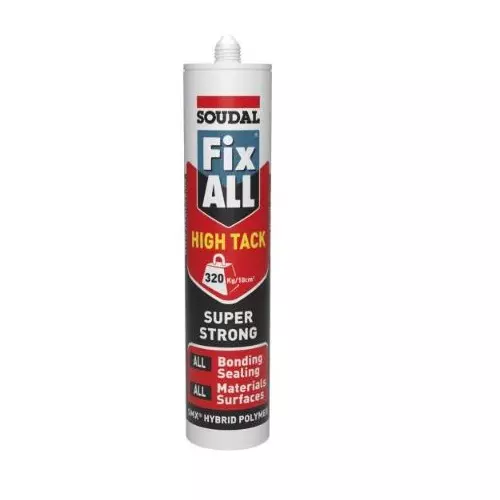
Fix All High Tack
When comparing products for your project, use the specifications for Fix All High Tack to check the required configuration. Use product code FAW when selecting or ordering this item.
Fix All High Tack is the perfect solution for all your bonding and sealing needs. Engineered to provide exceptional strength and adhesion, this versatile adhesive is suitable for a range of applications, from construction to DIY projects. Its advanced formula ensures a strong initial tack, making it suitable for vertical and overhead use without additional support.
Unmatched Versatility and Durability.
This high-performance adhesive bonds effortlessly to a variety of surfaces, including wood, metal, concrete, glass, and plastics. Whether you’re tackling interior or exterior projects, Fix All High Tack delivers reliable results. Its moisture-resistant and flexible properties ensure long-lasting performance, even in challenging environments like bathrooms and kitchens.
Key Benefits of Fix All High Tack.
Fix All High Tack offers more than just adhesion; it’s a comprehensive solution for bonding and sealing. Its gap-filling capability ensures smooth, professional finishes, while its solvent-free formula makes it environmentally friendly and safe to use. Choose Fix All High Tack for unmatched strength, durability, and versatility.
Start by identifying the role this item will have in the finished project. Compare the stated product details with the existing installation or the drawings for the proposed work. Pay particular attention to dimensions, finish and the intended connection with other materials. Where the available information does not establish compatibility, obtain confirmation before placing an order.
Inspect the area where the product is to be used before starting. Existing damage, loose material or an uneven surface may need separate attention. The appropriate preparation and fitting method depend on the product and its surroundings, so refer to the actual manufacturer's guidance rather than applying instructions from a different item that happens to look similar.
Consider the order in which related components will be installed. Some details are easier to resolve before adjacent materials are fitted, and access may become restricted as the project progresses. Check the items needed for the full assembly and establish which are included and which must be ordered separately. Keep any required technical instructions available on site.
Where the appearance of the finished work matters, compare the relevant colours, surface textures and profiles together. Lighting, surrounding finishes and the age of existing materials can affect how well a new component matches. A sample or direct comparison is useful when an exact match is necessary, especially in an extension or repair to an established installation.
Allow time to inspect the delivered materials before installation. Compare their identifying labels with the order and check for obvious damage or missing components. Keep items in the condition recommended by the manufacturer until they are needed, and avoid exposing finished surfaces to unnecessary damage during other building work. This is easier than discovering a problem once the materials have already been cut or fitted.
Before making irreversible cuts or alterations, compare the item with the actual installation and check the necessary clearances. Where the system instructions permit trial positioning, use it to assess the layout before final fixing. If a proposed change affects the product's function or compatibility, obtain advice specific to the item before proceeding.
For ordering purposes, use the product reference in this listing alongside the name and any selected option. A product family may contain several sizes or finishes, and the name shared by that family does not identify every individual version. Check that the reference on the order confirmation matches the item required, particularly when several similar components are being purchased for the same project.
If the product is being purchased for a repair, record the existing item and its surroundings before removing anything. Photographs, measurements and manufacturer references can make it easier to compare the replacement with the original. Where an exact replacement is unavailable, check the implications of a different profile or specification for the remaining components, rather than assuming it can be substituted without changes.
Think about how the finished area will be accessed after the work is complete. If inspection, cleaning or replacement is likely to be necessary, consider whether the planned layout allows for it without disturbing unrelated materials. Follow the maintenance and access requirements for the particular system, especially where a component will be concealed by subsequent work.
For more information on Fix All High Tack talk to Building Plastics Online Limited