 Get Listed


110mm Channel Drain with Plastic Grate
Product Code: D700
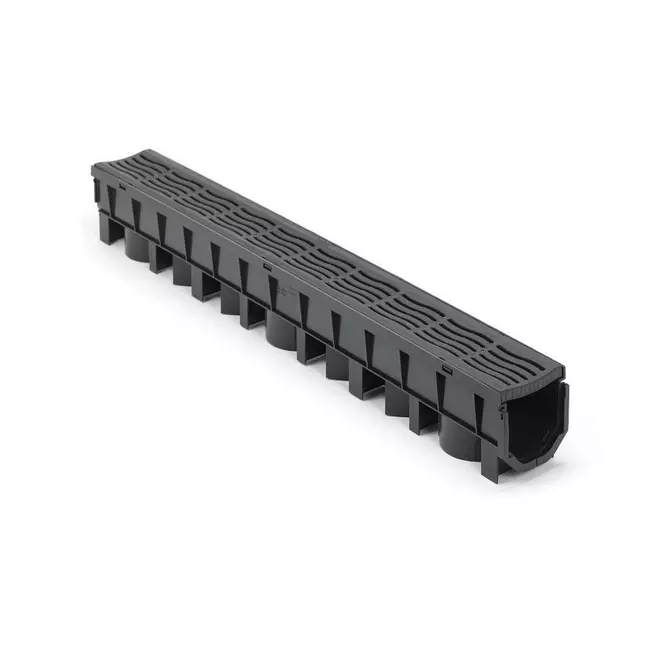
110mm Channel Drain with Plastic Grate
Select the fitting to suit the pipework layout. The 110mm Channel Drain with Plastic Grate is the product specified here. Use product code D700 when selecting or ordering this item.
FloPlast 110mm Channel Drain with Plastic Grate – Efficient Surface Water Management.
The FloPlast 110mm Channel Drain with Plastic Grate is designed to effectively collect and manage surface water in various domestic areas. Its robust construction and thoughtful design make it suitable for installations in driveways, pathways, patios, and gardens.
Design and features; Dimensions: Length: 1 meter; Width: 1002mm; Height: 114mm; Depth: 127mm.; Material: Made from quality polypropylene, ensuring durability and resistance to environmental factors.
Load Class A15: Manufactured to BS EN 1433 standards, supporting loads up to 1.5 tonnes, making it suitable for pedestrian and light vehicular traffic areas.
Anti-Slip Heel Guard Grating: Features an anti-slip heel guard design, enhancing safety by preventing slips and accommodating pedestrian traffic without hazard.
Concave Grid Design: The concave grid enhances water flow efficiency, ensuring rapid drainage and reducing the risk of pooling.
Applications.
This channel drain is ideal for domestic areas where surface water collects, including:
Driveways (light vehicles only); Pathways; Patios; Conservatories; Swimming pool areas; Sports areas; Gardens; Water features; Retaining walls; Installation and Maintenance.
The grate is easily removable with a flat-head screwdriver, simplifying cleaning and maintenance. The design eliminates the need for locking bars, streamlining the installation process.
For detailed installation guidance, refer to the FloDrain Domestic Channel Drainage System Installation Video provided by FloPlast.
In summary, the FloPlast 110mm Channel Drain with Plastic Grate offers a durable, efficient, and user-friendly solution for managing surface water in various domestic environments, ensuring both functionality and safety.
Start with a drawing of the complete drainage or rainwater run, including the positions where water enters, changes direction and leaves the system. A fitting should be selected to suit its particular position in that layout. Confirm the relevant nominal size and profile, since components with a similar appearance are not necessarily designed to connect to one another.
Consider how the system will be supported and how it can be inspected after installation. The required fall, joint arrangement and access provisions depend on the type of drainage system and its intended use. Establish those details from the applicable installation guidance before work begins. For underground or concealed work, check the surrounding ground or structure and the requirements for the completed system.
If the project involves replacing a damaged component, identify the existing manufacturer's range and connection type wherever possible. Measure the old fitting and the adjoining components, and check the cause of the original problem before replacing it. A new fitting may not resolve an issue arising from a blocked outlet, incorrect support or an unsuitable arrangement elsewhere in the run.
A complete system should be assessed for the expected flow and the conditions in which it operates. Where capacity or compliance is important, consult the published specifications or seek advice from a competent installer. Once the work is complete, check the connections and relevant access points in accordance with the system guidance and retain a record of the installed components for future maintenance.
Check what is supplied with the item and what is required separately before arranging work. A description of a larger system does not necessarily mean that all of its components are included in a single listing. Refer to the product information and packing details for the chosen option, and contact the supplier if the required contents or compatible accessories are not clear.
For larger projects, prepare a list of materials and check quantities against the final measured layout. Group items by their intended position so that similar components are not confused during fitting. This also makes it easier to identify which sizes or finishes still need to be ordered if the design changes before the work is complete.
Think about how the finished area will be accessed after the work is complete. If inspection, cleaning or replacement is likely to be necessary, consider whether the planned layout allows for it without disturbing unrelated materials. Follow the maintenance and access requirements for the particular system, especially where a component will be concealed by subsequent work.
For more information on 110mm Channel Drain with Plastic Grate talk to Building Plastics Online Limited