 Get Listed

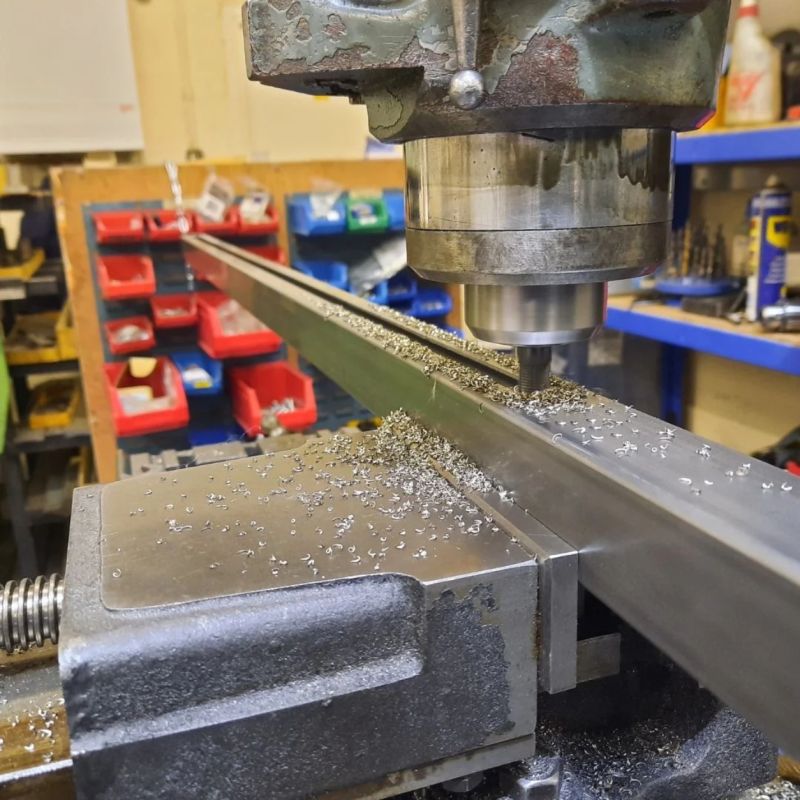
Long-span hollow sections can look straightforward on a CAD drawing, but machining accurate slots and hole patterns along their length presents a very different challenge on the workshop floor.
Ashland Engineering recently highlighted the importance of workholding, support and controlled machining when producing long structural guide rails and similar components where straightness, hole position and slot geometry all need to remain consistent over an extended length.
Why Long Sections Can Distort During Machining
If a long steel tube is clamped in a conventional milling vice without sufficient support, the unsupported ends can droop under their own weight. At the same time, excessive clamping pressure can distort the relatively thin walls of the hollow section.
Residual stresses within rolled material can also be released as machining progresses, adding another potential source of movement.
The result can be bowed slots, off-centre mounting holes or dimensional variation that only becomes obvious when the finished component is assembled into a larger system.
For guide rails, linear bearing supports and other precision structural components, even relatively small deviations can create problems such as binding, poor alignment or inconsistent fastener positioning.
Engineering the Workholding Before Cutting Begins
To minimise these risks, Ashland Engineering plans the workholding arrangement before the cutter is engaged.
The machine vice is aligned accurately with the machine's X-axis travel, while outboard supports are positioned at table height to prevent the unsupported length of the section from sagging.
Clamping pressure is also controlled carefully. Precision parallels and internal support blocks can be used where required to keep the component secure without crushing or bowing the tube walls.
This approach helps ensure that the workpiece remains stable and correctly referenced throughout the machining process.
Controlling Heat and Machining Sequence
Machining strategy is another important consideration. Feed rates and cutting sequences need to be selected carefully to avoid unnecessary localised heat build-up, which can contribute to distortion as the job progresses.
By controlling the order of milling and drilling operations, the machinist can reduce the risk of one area moving before later features are produced.
Ashland's machine shop includes CNC milling, turning, drilling and tapping capabilities, supported by in-house CAD and CAM for components manufactured to customer drawings and specifications. :chatgpt-content-reference{index="0"}
Inspection Forms Part of the Process
Once machining is complete, features such as straightness, datum position and hole pitch need to be checked rather than assumed.
Ashland carries out its subcontract machining under an ISO 9001 certified quality management system, with dimensional inspection forming part of its wider approach to repeatability and controlled manufacture. :chatgpt-content-reference{index="1"}
This is particularly important for long-span components, where a small error introduced at one point can become much more significant across the full length of the part.
By combining suitable support, controlled clamping, planned machining sequences and final inspection, long hollow sections can be machined accurately without relying on oversized slots or post-machining straightening to compensate for distortion.
For manufacturers and designers specifying long guide rails, structural bars or similar precision components, the quality of the machining setup is every bit as important as the dimensions shown on the drawing.
For more information on Controlling Distortion When Machining Long-Span Hollow Sections talk to Ashland Engineering Ltd