 Get Listed

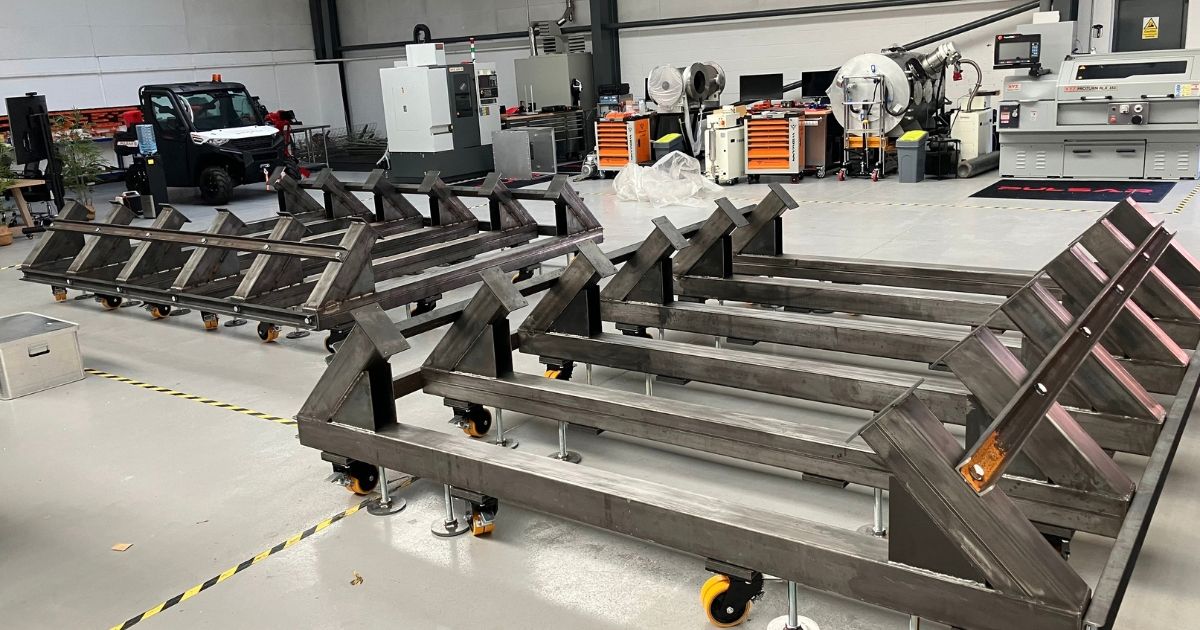
Ashland Engineering Ltd has outlined how it controls weld distortion when manufacturing batches of heavy-duty mobile assembly cradles, highlighting the importance of planning the fabrication sequence before welding begins.
In its latest LinkedIn update, the company describes structural cradles with long box-section base rails and a series of angled supports. The frames are designed to carry heavy payloads on castors and levelling feet, making consistent support alignment and rail flatness important to their finished performance.
Why repeated welds can distort a long frame
Ashland explains that adding substantial welds at the base of successive uprights introduces concentrated heat into the rails. As the welded areas cool and contract, the cumulative movement can pull a long beam out of shape.
Welding every support in sequence from one end of a frame to the other can compound this distortion. The result may be bowed rails and uneven support positions, despite the components appearing correctly aligned in the original CAD model.
Establishing the reference geometry
To manage this challenge, Ashland anchors the primary structural rails to precision modular welding tables. This establishes the baseline reference geometry and helps resist movement during fabrication.
The angled supports are then positioned together using precision spacing blocks. By setting their locations before the main welding work begins, the team can control pitch spacing and alignment across the assembly.
Sequencing heat input across the assembly
Ashland staggers its weld paths and alternates sides to balance heat input and manage shrinkage along the frame. The aim is to control distortion during manufacture, rather than relying on levelling adjustments or corrective force after welding.
The company says this approach is governed by its ISO 9001 quality management system and supports consistency across a batch, from the first unit to the last.
The example highlights why repeatable fabrication involves more than cutting identical parts. Fixturing, spacing and the order in which joints are welded all contribute to the geometry of the finished structure. Customers requiring bespoke fabricated frames or assemblies can contact Ashland Engineering to discuss their project.
For more information on Ashland Engineering explains weld distortion control for mobile assembly cradles talk to Ashland Engineering Ltd