 Get Listed

Can’t Afford to Automate? Think Again.
Can’t Afford to Automate? Think Again.
Increasing Productivity Without Buying New Machine Tools
For many manufacturers, the word “automation” immediately brings to mind expensive robotic cells, new machine tools, factory redesigns and significant capital expenditure. While these investments can deliver substantial returns, they are not the only route to higher productivity.
In reality, many machine shops are sitting on untapped capacity within their existing equipment. The challenge isn’t necessarily a lack of machines; it’s a lack of spindle utilisation.
The question manufacturers should be asking is not, “Can we afford to automate?” but rather, “Can we afford not to maximise the equipment we already own?”
By strategically upgrading workholding, material handling and unloading systems, manufacturers can achieve many of the benefits associated with automation without replacing a single machine tool.
The Hidden Cost of Idle Spindles
Every minute a spindle is not cutting material is lost production time. Yet many machining centres and lathes spend a surprising proportion of their working day waiting for operators to:
- Load and unload components
- Change fixtures
- Set up new jobs
- Adjust clamping systems
- Replenish bar stock
In some environments, spindle utilisation can be as low as 30–40%, meaning machines are generating revenue for less than half of the available production time.
The good news is that significant improvements can often be achieved through targeted upgrades rather than wholesale replacement.
Modern Workholding: The Fastest Route to Higher Throughput
One of the most effective ways to increase productivity is through advanced workholding systems.
Traditional single-vice setups often limit the number of components that can be machined in a cycle. Operators must stop production frequently to unload finished parts and prepare the next batch.
Modern workholding solutions from 1st Machine Tool Accessories can dramatically change this equation.
Chick Workholding Systems
Chick workholding systems are designed to maximise machine table utilisation and minimise setup times.
By replacing traditional single-station workholding with multi-station clamping systems, manufacturers can machine multiple components in a single cycle.
Benefits include:
- Up to 80% reduction in setup times
- Increased component density per cycle
- Improved repeatability and accuracy
- Reduced operator intervention
- Higher spindle utilisation
While conventional vice setups may only achieve 30–35% utilisation, multi-part fixtures and tombstone-style arrangements can push utilisation levels towards 85–95%.
The result is often a significant increase in throughput from the same machine tool with no additional floor space required.
Sinco Multizero: Flexible Modular Workholding
For manufacturers producing a wide variety of parts, flexibility is often just as important as productivity.
Sinco Multizero modular workholding systems allow fixtures to be exchanged quickly and accurately using a precision zero-point clamping system.
Instead of spending hours indicating and re-aligning fixtures, operators can remove and replace complete setups in minutes while maintaining exceptional positioning accuracy.
Advantages include:
- Rapid fixture changeovers
- Reduced machine downtime
- Greater machine flexibility
- Improved repeatability between jobs
- Easier implementation of palletised manufacturing strategies
For subcontractors handling high-mix, low-volume production, Sinco Multizero can significantly reduce non-cutting time while enabling faster response to customer demands.
OK-VISE: Unlocking Difficult Components
Not every production challenge requires large fixtures.
Many manufacturers struggle with awkwardly shaped components, limited machining access or parts that require multiple operations.
OK-VISE systems offer a highly versatile solution through low-profile wedge clamping technology that maximises access to the workpiece while maintaining secure clamping forces.
Benefits include:
- Greater access for five-sided machining
- Compact fixture designs
- High clamping forces in minimal space
- Reduced fixture complexity
- Improved machine table utilisation
For aerospace, medical, precision engineering and subcontract machining applications, OK-VISE can often transform jobs previously considered difficult or inefficient into highly productive operations.
Turning Centres: Extending Production Beyond Operator Hours
Machining centres are not the only equipment that can benefit from automation.
Turning operations often suffer from one simple limitation: somebody must continuously load new bar stock.
Every time a machine stops waiting for material, productivity drops.
Breuning IRCO Bar Feeders and Unloading Systems
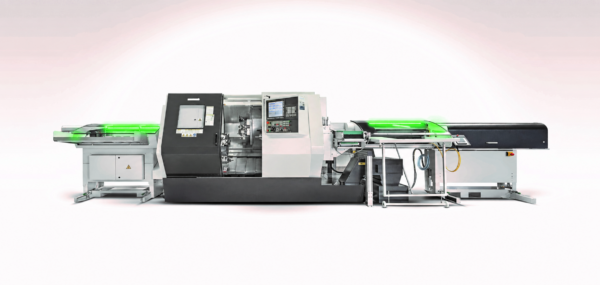
Breuning IRCO systems allow fixed-head and sliding-head lathes to operate continuously with minimal operator involvement.
By automatically loading bar stock and managing part unloading, these systems transform machine utilisation and enable extended unattended operation.
Benefits include:
- Continuous production
- Reduced operator workload
- Improved process consistency
- Increased parts-per-hour output
- Enhanced machine ROI
For many manufacturers, adding a bar feeder represents one of the fastest-return automation investments available.
A machine that previously required constant supervision can continue producing components throughout breaks, shift changes and, in some cases, overnight production periods.
Custom Solutions for Maximum Impact
Every manufacturing environment is different.
Some facilities require a combination of modular workholding, automated loading and custom fixturing to achieve their goals.
This is where engineered solutions become particularly valuable.
At 1st MTA, productivity improvements are rarely viewed as individual products. Instead, the focus is on identifying bottlenecks and creating complete solutions that maximise machine utilisation.
A machining centre may benefit from:
- Sinco Multizero quick-change workholding
- Chick multi-part fixtures
- OK-VISE low-profile clamping
- Bespoke fixture design
- Automated pallet handling
Similarly, a turning centre may combine:
- Breuning IRCO bar feeding
- Automatic unloading systems
- Custom workholding solutions
- Process optimisation strategies
The result is a tailored productivity package designed around the customer’s existing assets.
How Much Improvement Is Realistically Possible?
While results vary between applications, manufacturers commonly achieve:
- Setup time reductions of 70–80%
- Throughput increases of 30–50%
- Dramatically improved spindle utilisation
- Reduced operator intervention
- Faster job changeovers
- Greater flexibility for mixed production environments
Most importantly, these gains are often achieved without purchasing new machine tools or expanding factory space.
Automation Doesn’t Always Mean New Machines
The most successful manufacturers understand that automation is not defined by robots alone.
True automation is about reducing wasted time, increasing spindle utilisation and enabling machines to produce more components with less operator involvement.
Whether through Chick multi-station workholding, Sinco Multizero zero-point systems, OK-VISE flexible clamping solutions, Breuning IRCO material handling equipment or bespoke engineered solutions, substantial productivity gains are often already within reach.
Before investing in another machine tool, it may be worth asking a simpler question:
How much more could your existing machines achieve?
For more information on Can’t Afford to Automate? Think Again. talk to 1st Machine Tool Accessories