AI adoption vs AI transformation
- 04 Nov 2026
- Articles

TL;DR
-
AI adoption measures individual tool uptake, whereas AI transformation redesigns operational processes, delivery roles, and commercial agreements.
-
Individual usage habits do not correlate with business success, while collaborative team-level AI practice directly predicts project outcomes.
-
A progressive framework spanning point adoption, wide adoption, shared competence, and organisational resilience guides sustainable operational change.
-
The fifteen-month internal case study from Future Processing demonstrates how structured skill development and governance double daily tool use across delivery roles.
AI adoption and AI transformation represent two fundamentally different operational states in an enterprise. In this guide, you will examine a fifteen-month internal case study published by Future Processing to understand why adoption measures simple tool uptake, whereas transformation requires systemic redesign.
High tool usage reflects individual employee habits rather than genuine business change. Transformation alters delivery processes, job roles, governance frameworks, and commercial models. Progression between these states demands structured capability building rather than technological procurement alone.
The progressive stages of the AI journey
Organisational progression from initial tool uptake to a redesigned operating model follows a structured four-stage route. This framework separates early tooling adoption from deep operational transformation.
Stages of adoption: point adoption and wide adoption
Point adoption marks the first stage, where individuals use artificial intelligence on their own initiative within existing security parameters. Value remains trapped with specific users during this phase, and teams duplicate effort. Executive leadership establishes strategic goals, allocates central budgets, and sets a baseline measurement.
Wide adoption introduces sanctioned, centrally funded tool access across all departments. Central funding ensures consistent tool availability across client accounts. A concise corporate policy establishes data handling rules and intellectual property boundaries. Fast approval channels operate within two working days and prevent unmonitored shadow AI.
Stages of transformation: shared competence and organisational resilience
Shared AI competence expands capability across existing job roles. Delivery teams integrate standardised practices into project workflows instead of treating artificial intelligence as an isolated specialism. Regular experimentation, peer learning, and defined competency benchmarks establish common working methods.
Organisational resilience represents the final stage, where the business adapts to technological change across its entire delivery and commercial structure. Teams absorb new tools and retire outdated systems without disrupting governance, compliance, or culture. At this level, methods proven across multiple engagements become formal delivery standards.
Why progression requires sequential order
Organisations cannot bypass the early stages of this journey. Mentors and skill initiatives can spread common practices in stage three, but leadership must define the operational purpose in stage one. Attempts to skip stages lead to stalled initiatives, inconsistent execution, and change fatigue.
In its AI Transformation Case Study, Future Processing documented a fifteen-month internal programme that tracked this sequential progression. Stage one required several months of strategic planning, stage two took one quarter, and stage three required six months to establish. Stage four remains an ongoing operational state so that delivery models adapt as technology evolves.
Why do usage metrics fail to measure transformation?
Individual usage metrics reveal employee habits, but only team-level AI practice indicates whether a business has changed how it delivers work. Adoption surveys capture tool uptake without demonstrating operational redesign. Sustainable commercial value requires teams to coordinate their methods rather than rely on isolated personal use.
The gap between individual habits and team practice
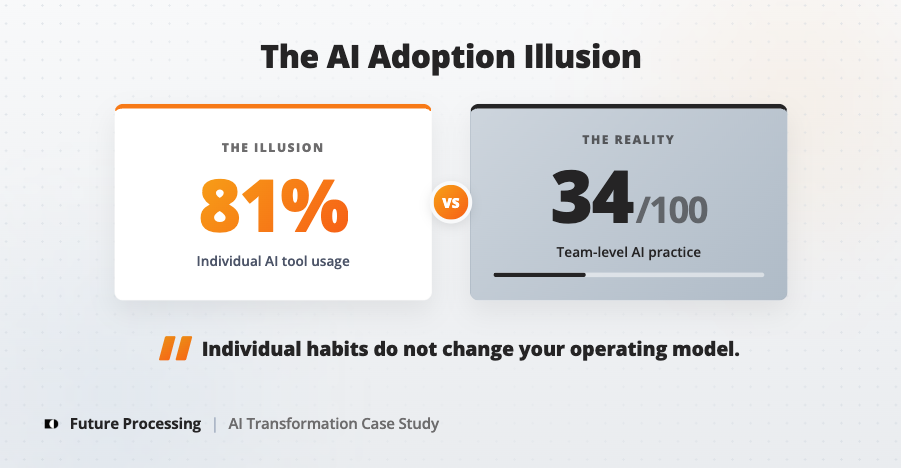
Internal surveys often produce misleading adoption headlines. In the 2025 baseline survey conducted by Future Processing, 81% of staff reported using AI tools, yet those same employees rated their team-level practice at only 34 out of 100. The high figure reflected personal habits, while the lower score revealed an operating model that had not yet adapted.
Survey analysis categorises adoption into four distinct steps on a ladder. Employees discover tools, try them occasionally, apply them regularly to personal tasks, and integrate them into repeatable team workflows. Individual use alone does not predict project success, whereas team practice correlates directly with project outcomes (correlation r = 0.42 in the 2026 programme evaluation). This confirmed relationship demonstrates that collective habits determine business performance.
Workstream bottlenecks and systemic measurement
Time savings deliver business value only when the entire delivery chain accelerates. If an engineer completes a task an hour earlier but code review or quality assurance runs on its traditional schedule, the client gains nothing. Accelerated code generation frequently relocates the primary operational constraint downstream into manual code review.
Effective transformation measurement requires repeated, comparative instruments. The documented programme at Future Processing captured an initial baseline of 446 respondents in summer 2025 and conducted a second wave in April 2026 with 480 respondents, which featured a matched panel of 293 individuals. Team-level practice rose from 34 to 52.7 out of 100 between 2025 and 2026, while daily use doubled across delivery roles.
The programme paired subjective surveys with an objective maturity rubric across four areas: People, Governance, Practices and methods, and Tooling, data and compliance. Quarterly assessments scored delivery units across five observable levels, from exploratory experiments to transformational operations. This dual approach prevented unverified claims of hours saved from clouding genuine capability gains.
How can organisations build capability and governance across existing roles?
Sustainable transformation embeds AI competencies within existing job profiles rather than isolating skills in a dedicated artificial intelligence department. Companies build lasting capability by upgrading standard roles across engineering, delivery, and operations. This approach prevents organisational silos and accelerates practical adoption across client engagements.
Role-based skills and community structures
Capability building succeeds when artificial intelligence functions as a standard professional skill, similar to source control or language proficiency. Every delivery role shares a common foundation covering language model fundamentals, prompt engineering, and security principles. Technical staff self-assess across four capability levels based on daily execution rather than theoretical familiarity.
Internal peer networks accelerate capability development across delivery teams. The internal programme at Future Processing deployed approximately 35 experienced specialists as AI Masters in 2026, who spent dedicated hours establishing delivery standards and advising complex engagements. Each delivery team appointed an AI Champion, typically a technical lead, to oversee practical execution and experiment logs.
Regular knowledge exchanges maintain broad engagement across disciplines. Informal community sessions, known as AI Coffee, established a repository of over thirty technical recordings covering practical automation solutions. An open corporate register captured 266 experiments across departments by 2026 and recorded documented failures as essential organisational learning.
Centralised access and compliance guardrails
Practical governance prevents shadow AI through rapid, centrally funded software access. Corporate procurement approved tool requests within two working days so teams avoided unmonitored personal accounts. Centralised billing established immediate visibility over operational spend while preventing licences from expiring alongside individual project contracts.
Dynamic risk management replaces restrictive bans with contextual reviews. A conversational Compliance Assistant evaluated planned implementations against approximately 150 classified everyday tasks under the 2026 governance framework to divide activities into low, medium, or high risk. High-risk proposals required mitigation and formal mandate acceptance, while mandatory training ensured staff complied with GDPR, the EU AI Act, and ISO 27001 standards.
AI-native delivery and commercial redesign
AI-native delivery integrates automation into every project phase rather than layering standalone tools onto traditional development cycles. Software delivery teams rethink specifications, team sizing, quality gates, and deployment rhythms in unison. This comprehensive redesign ensures projects achieve consistent acceleration without compromising software quality.
Specification-driven development and team composition
Comprehensive technical specifications replace loose coding workflows. Teams define system goals, operational parameters, and acceptance criteria upfront so autonomous agents can build solutions safely. Strict human oversight governs this output: engineers write all core business logic, such as payment calculations, while automated systems draft routine code subject to mandatory peer review.
Project teams deploy tiered engagement levels based on data sensitivity and contract parameters. Engagements operate across crawl, walk, and run stages so that sensitive data remains protected under strict human supervision. Multi-disciplinary teams of two or three T-shaped practitioners now replace traditional hand-off chains of eight specialists and unite discovery with construction workflows.
Commercial models and partner evaluation
Accelerated delivery timelines necessitate a fundamental departure from hourly billing. When small, augmented teams deliver projects 30% faster than historical benchmarks in verified 2026 client pilots, time-based invoices penalise efficiency. Modern commercial arrangements link compensation directly to verified business outcomes and agreed milestones.
Internal workflow redesign produces measurable delivery efficiencies across operations. Documented 2026 methods reduced technical documentation generation from two to three days to under 30 minutes per subproject. Data platform migration routines condensed two days of effort into four to six hours per data product across fifty assets, while presales teams handled 40% more proposals.
Move from adoption to transformation
The transition from simple tool adoption to complete organisational transformation demands methodical execution and patience. Technology leaders must align internal skills, team practices, and risk governance before expecting commercial returns. Daria Polończyk, Head of Delivery at Future Processing, noted that delivery acceleration requires corresponding client alignment on acceptance testing and decision cycles.
Technology and business leaders can examine the complete data, frameworks, and survey methodologies in the full Future Processing case study report, 'Our path from AI adoption to AI transformation'. The publication provides practical rubrics, governance templates, and implementation roadmaps. Corporate leaders and procurement directors can download the complete report directly from the case study landing page.
Frequently asked questions
What is the difference between AI adoption, AI maturity, and AI transformation?
AI adoption measures simple tool uptake through surveys, AI maturity scores organisational capability across defined competence centres, and AI transformation redesigns delivery models and commercial structures. Assessment frameworks often adapt industry rubrics into five distinct levels to evaluate capability rather than relying on binary adoption percentages.
What stages define the journey from AI adoption to AI transformation?
The operational journey spans point adoption, wide adoption, shared AI competence, and permanent organisational resilience. Transformation initiatives stall when organisations attempt stage-three capability building without the executive mandates defined in stage one, which triggers change fatigue as uncoordinated operating models continually adapt.
How do organisations measure whether an AI transformation succeeds?
Leadership teams track repeated workforce surveys alongside quarterly maturity assessments that evaluate observable indicators across delivery units. Robust programmes discard unverified claims of hours saved unless paired with task frequency data, because declared time savings on infrequent tasks fail to move delivery baselines.
When does artificial intelligence fundamentally change delivery workflows?
Operations change when methods graduate through a three-step route from experiment to validated use case and into a formal delivery standard proven across multiple client engagements. Successful implementation in non-delivery functions also contracts lead qualification response times from 20 working hours to six hours while reducing unreachable leads by 60%.
What questions should buyers ask when evaluating an AI delivery partner?
Buyers must confirm whether supplier contracts distinguish between data grounding and model training, and verify that strict human oversight governs core business logic such as payment calculations. Procurement teams should also require multi-vendor tool independence to prevent vendor lock-in as ongoing operational expenses surpass initial build budgets.